To understand this topic clearly, first remember that machines only learn from data. Data is of two types: labeled and unlabeled. Labeled data means the information that already has answers. Unlabeled data means it is without answers. Semi-supervised machine learning, combines both types, making it easier for a computer to learn effectively even when complete information is not available.
In today’s world, Computers are getting smarter day by day. They can identify faces, recommend movies, translate languages, and even assist doctors. One major factor driving this smart behavior is semi-supervised machine learning. This method helps computers learn, just as humans do when they have only a little guidance.
Why Do We Need This Learning Method?
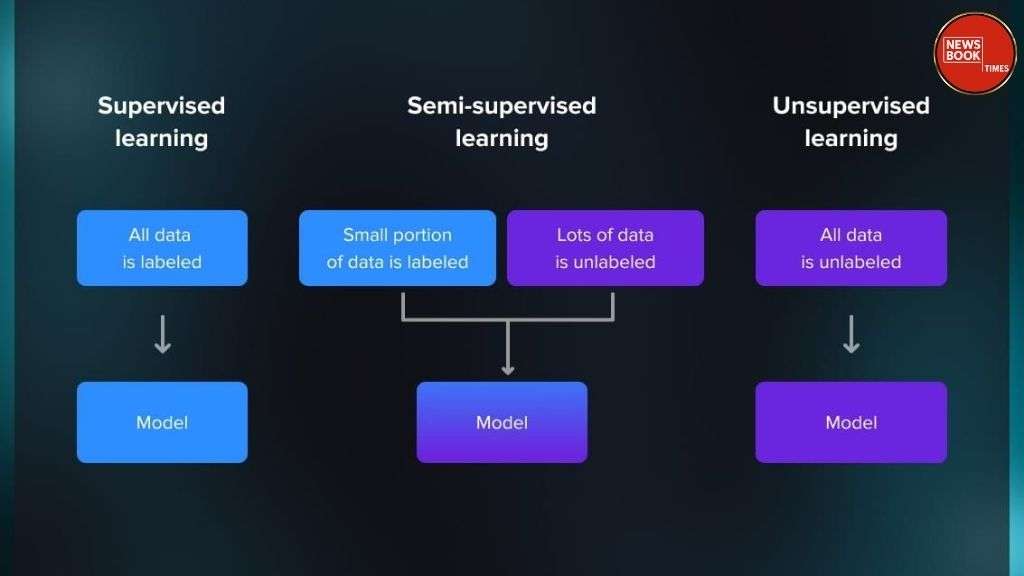
The problem is much more complex in real life because it is both expensive and challenging to obtain labeled training data. For example, labeling thousands of medical reports or customer reviews requires a significant amount of time and expert effort. On the other hand, a large amount of unlabeled data is available. Semi-supervised machine learning becomes useful in this case because it enables the computer to learn from a small set of labeled data and a large set of unlabeled data.
This makes learning faster, cheaper and more realistic. It’s a strategy that many modern systems rely upon to work efficiently.
How Does It Work in Simple Words?
Consider a computer like a learner who knows a few correct answers but sees many unanswered questions. With semi-supervised machine learning, the computer examines the labeled data quite closely at first. Then, it views the unlabeled data and detects patterns that fit with what it already knows. With every step, it improves its understanding.
This approach is nearly identical to natural learning. The computer does not need answers for everything. It learns things by observing patterns, similarities, and differences.
Read Also: Supervised Machine Learning
Practical Example
Imagine a company that wants to sort through thousands of customer emails. Only a few emails are marked as “complaint,” “feedback” or “query.” Most emails have no labels. Employing semi-supervised machine learning, the system learns from a small number of labeled emails and then accurately categorizes additional emails by recognizing word patterns and topics.
This enables the company to respond more quickly and increase customer service without manually labeling every email.
Where Is It Used in Real Life?
This learning method is used in many important areas:
- Healthcare: Doctors label only a few medical scans, and the system learns to interpret many more scans.
- Finance: Banks identify fraud by studying a few confirmed fraud cases and many transactions of unknown status.
- Search engines: enhance results by using a mix of of tagged and untagged web pages.
- Image recognition: Systems recognize objects with a limited number of labeled images.
In all these cases, semi-supervised machine learning can save a lot of time and resources.
How Is It Different from Other Learning Types?
There are three categories of machine learning. Supervised learning learns from labeled data only. Unsupervised learning operates with the unlabeled data only. Semi-supervised machine learning stands in between. It takes the best of both.
This combination is what makes it powerful and flexible. It performs better than unsupervised learning and is cheaper than fully supervised learning.
Important Terms You Should Know
While learning this topic, you may hear some related terms.
- Machine learning models
- Artificial intelligence
- Data labeling
- Predictive analysis
- Pattern recognition
- Training data
These ideas work together with semi-supervised machine learning to make systems smarter.
Benefits of Semi-Supervised Learning
Advantages of using this approach include:
- It reduces the need for expensive labeled data
- It improves accuracy compared to unsupervised methods
- It works well with large datasets
- It is practical for real world problems
Because of these benefits, semi-supervised machine learning is becoming more popular in modern technology.
Read Also: Reinforcement Learning in Machine Learning
Conclusion
At last, semi-supervised machine learning is an innovative method by which computers learn using minimal guidance and extensive observation. It also helps machines make sense of data when the complete answers aren’t given. This significantly saves money, time, and effort while still providing good and reliable results. In today’s world, many advanced technologies rely heavily on semi-supervised machine learning to enhance performance as well as accuracy. From hospitals to banks, and from search engines to image recognition tools, this method typically plays a crucial role in various applications.
It enables machines to recognize patterns, make predictions, and improve decision-making. This is what makes technology faster, cheaper, smarter. As data continues to expand, this learning approach will play a significant role in artificial intelligence systems.